The Business Looks Simple — The Model Is Not
At first glance, McDonald’s appears to be a straightforward food business. It sells burgers, fries, and beverages at scale, supported by a global network of outlets.
This surface view leads to a common assumption: its success comes primarily from food sales and operational efficiency.
But the actual model operates differently.
McDonald’s does not behave like a traditional restaurant chain. It positions itself in a way that allows it to generate consistent revenue, reduce operational risk, and maintain control across thousands of locations—without directly running most of them.
Understanding how this works requires looking beyond the menu and into the structure of the business itself.
Revenue Doesn’t Come Mainly from Food
The core of McDonald’s model lies in how it structures its relationship with franchise operators.
Instead of owning and operating most outlets, McDonald’s allows independent operators to run them under its brand. These operators handle day-to-day activities such as staffing, inventory, and local management.
In return, McDonald’s earns revenue through:
- franchise fees
- royalties based on sales
- rent from properties
| Revenue Source | Description | Stability |
| Franchise Fees | Initial setup payments | One-time |
| Royalties | Percentage of sales | Recurring |
| Rent | Charged on property | Highly stable |
This structure shifts operational responsibility to the franchisee while allowing McDonald’s to earn predictable income streams.
Why This Changes the Business
A typical restaurant depends heavily on daily sales and operational efficiency. McDonald’s, however, earns a significant portion of its income regardless of short-term fluctuations at individual outlets.
By focusing on royalties and rent, the company reduces direct exposure to operational variability while maintaining a share in overall performance.
The Real Strategy: Control the Location
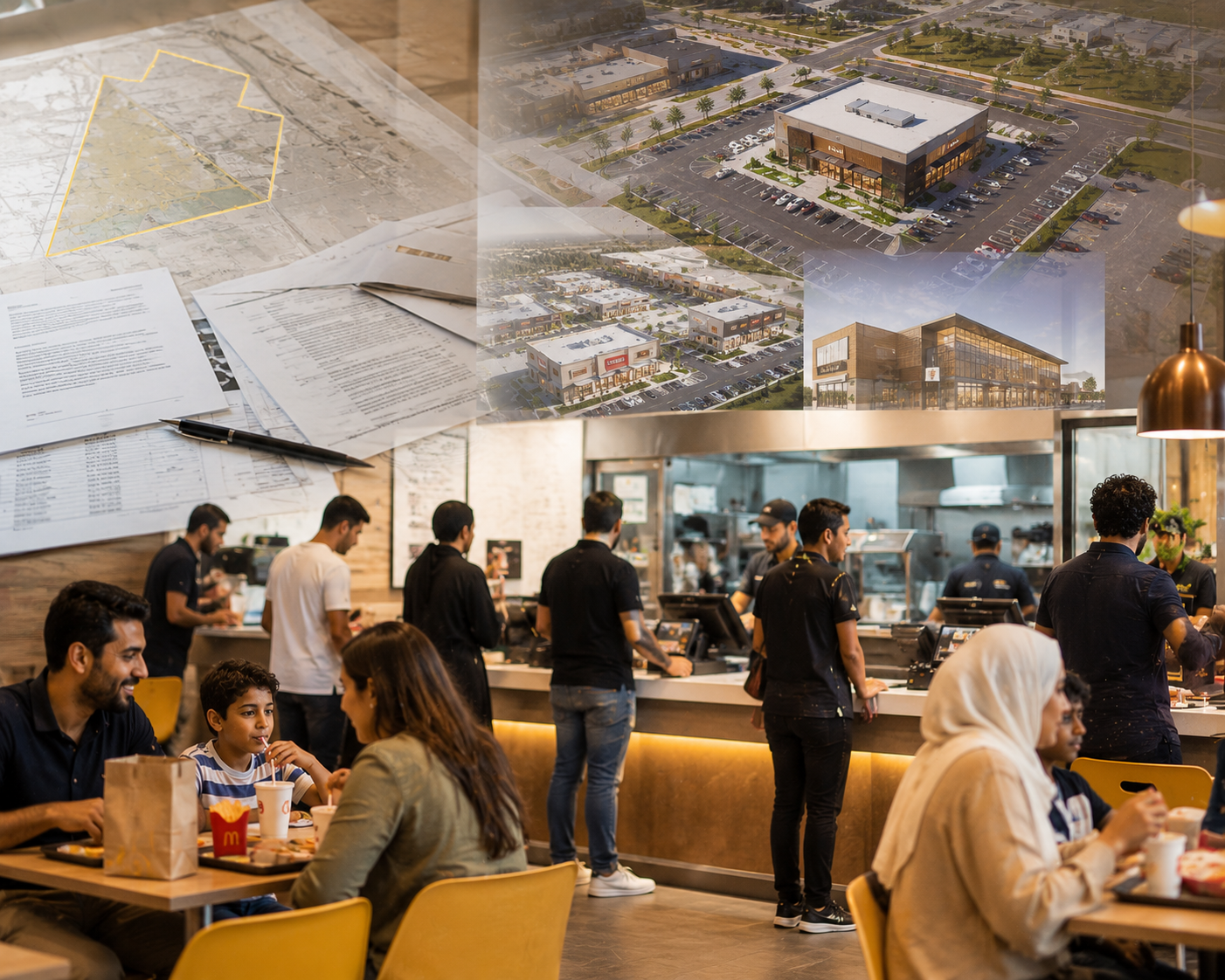
One of the most defining elements of McDonald’s model is its approach to real estate.
In many cases, McDonald’s owns or controls the land and property where its outlets operate. It then leases these locations to franchise operators.
This creates a layered structure:
- the franchisee runs the business
- McDonald’s owns or controls the underlying asset
From a business perspective, this shifts the model from pure food operations to asset-backed revenue generation.
Owning prime locations ensures:
- long-term control over key markets
- steady rental income
- strategic positioning in high-demand areas
Over time, the value of these locations often increases, adding another dimension to the company’s financial strength.
What Makes the Model Resilient
The combination of franchising and real estate creates a system that is both scalable and resilient.
Franchisees invest their own capital to set up and operate outlets. This reduces the financial burden on McDonald’s while allowing rapid expansion. At the same time, standardized processes ensure consistency across locations.
The real estate component adds another layer of stability. Rent payments provide predictable income, even when individual outlets face fluctuations.
This dual structure—operational decentralization with centralized control—allows McDonald’s to grow without taking on the full risk associated with expansion.
Where Most People Misunderstand the Business
The most common misunderstanding is viewing McDonald’s as a company that primarily sells food.
While food is the visible product, it is not the core driver of the model. The business is structured around controlling assets, managing brand standards, and earning from the performance of a distributed network.
This distinction becomes clearer when comparing it to independent restaurant owners.
A small restaurant depends entirely on:
- daily footfall
- cost control
- operational efficiency
McDonald’s, in contrast, earns from:
- system-wide sales
- property control
- standardized operations
This difference explains why the company can maintain stability across different markets and economic conditions.
It also highlights a broader principle seen in many successful businesses—control over the underlying system often matters more than control over individual transactions.
Lessons That Translate to Smaller Businesses
While the scale of McDonald’s is unique, the underlying principles are not limited to large corporations.
One key takeaway is the importance of structuring revenue in a way that reduces dependence on daily fluctuations. Businesses that rely entirely on single-point transactions are more vulnerable to volatility.
Another lesson is the value of controlling critical assets. This does not necessarily mean owning real estate, but it can involve controlling distribution channels, customer relationships, or supply chains.
These principles also connect with how early-stage businesses are built. In the validation of a business idea, the focus is often on whether demand exists. But once demand is established, the next step is structuring the business to capture that demand sustainably.
Similarly, pricing decisions—explored in pricing strategy for small businesses—affect not just revenue, but how predictable and stable that revenue becomes over time.
Why the Model Works at Scale
Scaling a traditional restaurant model requires significant capital and operational oversight. Each new location adds complexity, cost, and risk.
McDonald’s model avoids this by distributing responsibility.
Franchisees invest capital, manage operations, and bear a portion of the risk. McDonald’s, in return, provides the brand, systems, and infrastructure.
This allows expansion without proportional increases in operational burden.
At the same time, centralized control over standards ensures that the brand remains consistent across locations. This balance between decentralization and control is what makes the model effective at scale.
The Underlying Principle: Structure Determines Outcome
The success of McDonald’s is not just about execution—it is about how the business is structured.
Two companies can sell similar products but produce very different outcomes depending on how they generate revenue, manage assets, and distribute risk.
McDonald’s demonstrates that:
- controlling the system is more valuable than controlling each unit
- recurring revenue is more stable than transactional income
- asset ownership can strengthen long-term positioning
These principles apply across industries, even at smaller scales.
The Model Behind the Menu
What appears to be a global food chain is, in practice, a carefully structured system built on franchising and asset control.
The visible layer—food, branding, and customer experience—is only one part of the business. The underlying structure determines how revenue is generated and how risk is managed.
For anyone building or analysing a business, this distinction matters.
The product may attract customers. But the structure determines whether the business can grow, sustain itself, and remain stable over time.