More Orders Don’t Always Mean More Profit
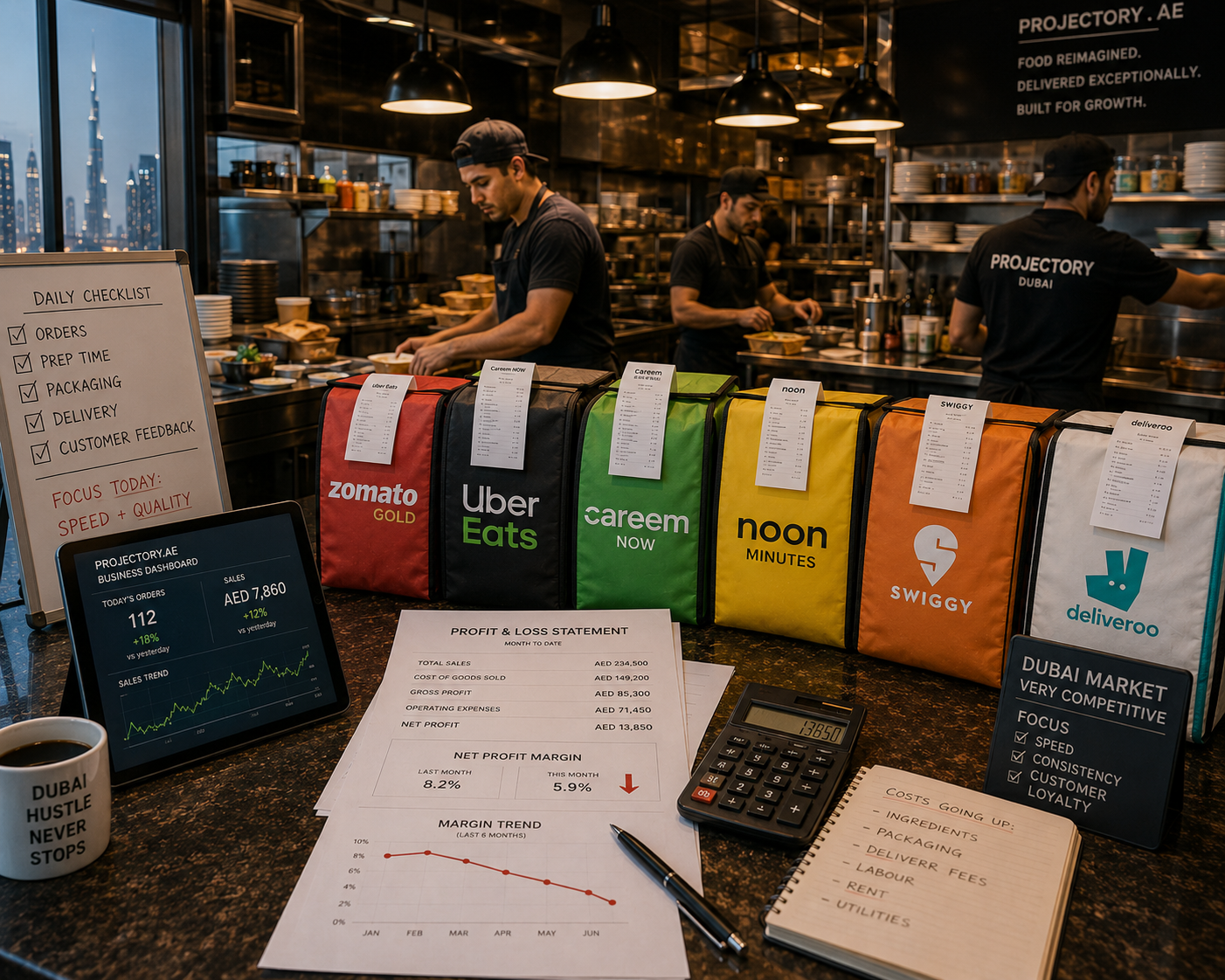
For many small food businesses, joining delivery platforms like Zomato, Swiggy, Noon Food, Careem, etc feels like a turning point.
Orders increase quickly. A business that once depended on footfall begins receiving consistent digital demand. The shift is immediate and visible. Revenue rises, customer reach expands, and the business appears to gain momentum.
At this stage, platforms feel like growth infrastructure.
But over time, a different pattern begins to emerge. Despite higher order volumes, the business does not feel financially stronger. Margins remain tight, cash flow becomes unpredictable, and operational pressure increases.
The business is busier—but not necessarily more stable.
This is where the distinction between activity and sustainability becomes critical.
What Platforms Actually Change
Platforms do more than add orders. They change the structure of the business itself.
Before platforms, demand is location-driven. Customers discover the business through proximity, visibility, or word of mouth. After platforms, demand becomes algorithm-driven. Visibility depends on rankings, reviews, pricing competitiveness, and platform dynamics.
This transition shifts control.
The business no longer fully controls how customers discover it. Instead, it operates within a system where exposure is mediated.
In the early stage, this works in favor of the business. Platforms reduce friction in customer acquisition and provide immediate access to demand. This is particularly valuable when demand is still being tested, similar to early-stage validation dynamics explored in how to validate a business idea.
However, what begins as access gradually becomes dependency.
The Economics Behind Each Order
The most direct impact of platforms appears in unit economics.
Consider a simplified order:
- Order value: $10
- Platform commission (25%): $2.50
- Net received: $7.50
| Component | Amount |
| Order Value | $10.00 |
| Platform Commission | $2.50 |
| Net to Business | $7.50 |
From the remaining amount, the business must cover all operational costs—ingredients, labor, packaging, rent, and utilities.
The margin that remains is significantly lower than a direct order.
At a small scale, this difference may not appear critical. But as volume increases, the cumulative impact becomes substantial.
Volume Without Margin Creates Illusion of Growth
One of the most common misinterpretations in platform-based businesses is equating order volume with financial progress.
Higher volume creates visible growth. Orders increase, revenue numbers improve, and activity levels rise. But if margins are compressed, the underlying financial position does not improve proportionally.
This creates an illusion.
The business appears to grow, but its ability to retain profit does not increase at the same rate. In some cases, it may even decline.
This pattern is not unique to platforms. It reflects a broader principle seen in operational businesses, including the Dubai cafeteria case study, where high activity can coexist with tight margins.
Pricing Becomes a Competitive Constraint
Pricing flexibility is one of the first areas affected by platform dependence.
On a platform, the customer sees multiple alternatives instantly. Products are compared side by side, often with minimal differentiation. This shifts decision-making toward price sensitivity.
A small increase in price can reduce visibility or conversion. At the same time, maintaining lower prices limits the ability to offset commissions.
This creates a structural constraint.
Pricing is no longer a fully internal decision. It becomes influenced by the competitive environment of the platform.
This constraint aligns with broader pricing challenges discussed in pricing strategy for small businesses, where balancing demand and sustainability becomes critical.
Dependency Is Not Immediate — It Accumulates
Dependency on platforms does not happen at once. It develops gradually.
At first, platforms act as an additional channel. They complement existing demand. Over time, they begin to dominate.
The business shifts from:
- optional platform usage
to - reliance on platform-driven demand
As this shift occurs, several changes follow.
Customer relationships become indirect. Repeat customers continue ordering through the platform rather than engaging directly. The business gains volume but loses visibility into customer behavior.
At the same time, platform policies—commissions, promotions, ranking algorithms—begin to influence performance.
The business grows within a system it does not control.
The Transition Most Businesses Don’t Notice
A typical transition looks like this:
A restaurant begins with strong walk-in demand and uses platforms to supplement it. As platform orders increase, they become the primary revenue source.
Over time, the share of direct orders declines.
At that point, the business is no longer using the platform—it is operating through it.
This transition often goes unnoticed because it is gradual. By the time it becomes visible, reversing it is difficult.
Cash Flow Becomes Less Predictable
Beyond margins, platforms also affect cash flow patterns.
Payments are settled in cycles, not instantly. Adjustments for commissions, discounts, and promotions introduce variability. The business receives revenue, but not always in a predictable or immediate way.
For businesses operating with limited working capital, this creates pressure.
The issue is not just how much money is earned, but when it becomes available.
This reinforces a core principle discussed in cash flow vs profit, where timing plays a critical role in financial stability.
Why Businesses Still Rely on Platforms
Despite these challenges, platforms remain central to modern food businesses.
They solve problems that are otherwise difficult to address:
- customer acquisition at scale
- delivery logistics
- digital presence
For new businesses, especially, platforms provide immediate access to market demand without requiring significant upfront investment.
In many cases, avoiding platforms entirely is not a practical option.
The real question is not whether to use them—but how to use them without losing control.
Turning Platform Usage Into a Structured Strategy
Businesses that manage platform dynamics effectively do not treat them as the foundation of the business. They treat them as one channel among many.
This distinction changes how decisions are made.
Instead of optimizing only for platform performance, these businesses focus on maintaining balance. They use platforms for visibility and demand generation, while gradually building direct customer relationships.
This may involve:
- encouraging repeat customers to order directly
- differentiating pricing or offerings outside the platform
- maintaining operational efficiency despite commission pressure
These are not immediate transformations. They are gradual adjustments that shape long-term sustainability.
Platform Growth Is Not Business Growth
A business can grow in platform metrics—orders, rankings, visibility—without strengthening its underlying structure.
True business growth requires:
- stable and sufficient margins
- control over customer relationships
- predictable cash flow
- operational flexibility
Without these, growth remains dependent.
This distinction is critical because it determines whether the business can sustain itself independently of the platform.
Access Comes With Trade-Offs
Platforms provide access. But access is not neutral—it comes with trade-offs.
They expand reach but reduce control. They increase demand but compress margins. They simplify logistics but introduce dependency.
For small businesses, these trade-offs are not inherently negative. They become problematic only when they are not understood.
Using platforms effectively requires recognizing both sides of the equation.
Growth That You Don’t Control Is Not Stable
The most important takeaway is this:
Growth that depends entirely on an external system is not fully owned.
A business may appear to expand, but if that expansion is tied to factors outside its control, it remains vulnerable.
Sustainable growth requires control over:
- customer relationships
- pricing decisions
- operational structure
Platforms can support growth. But they cannot replace the foundation of the business.
Understanding this distinction allows businesses to use platforms strategically—without becoming dependent on them.